Water-Damaged Hardwood Floor Repair: Can Your Floors Be Saved?
Water and hardwood are a difficult combination — but damage does not always mean replacement. Here is how to assess the situation, what steps to take immediately, and when repair or refinishing is a realistic path forward.
Water and hardwood floors are a difficult combination. Whether the source is a slow plumbing leak, a dishwasher overflow, flooding, or years of humidity imbalance, moisture can change the shape, stability, and appearance of solid and engineered hardwood in ways that range from cosmetic to structural.
The good news: water damage does not automatically mean replacement. The outcome depends on the moisture source, how long the floor was exposed, the species and construction of the wood, and the condition of the subfloor underneath. This guide walks through what to look for, what to do immediately, and how to think through your repair options.
Common Signs of Water Damage in Hardwood Floors
Wood is hygroscopic — it absorbs and releases moisture from its environment. When that process is disrupted by a sudden water event or prolonged exposure, the boards respond in predictable ways.
Cupping is one of the earliest signs. The edges of individual boards rise higher than the center, giving the floor a washboard appearance. It happens when the bottom of the board absorbs more moisture than the top, causing the wood to swell unevenly. Cupping is often reversible if caught early and the moisture source is corrected.
Buckling is more severe. Boards lift entirely off the subfloor, sometimes by an inch or more. This typically follows a significant water event — flooding, a burst pipe, or a major appliance leak — and indicates that the wood has expanded beyond the space available to it. Buckled boards are not always a total loss, but the subfloor must be assessed carefully before any repair work begins.
Staining and discoloration can appear as dark spots, gray patches, or black streaking. Dark staining often indicates that moisture has been present long enough for tannins in the wood to react, or for mold and mildew to begin forming in the wood fibers or beneath the floor. Surface staining from a recent event may sand out; deep black staining usually does not.
Loose or squeaky boards after a water event can signal that adhesive has failed, fasteners have loosened, or the subfloor itself has been compromised. A floor that was previously solid and quiet should be investigated if it develops movement or noise following moisture exposure.
Soft spots or springiness underfoot are a warning sign that the subfloor — typically plywood or OSB — has absorbed water and begun to delaminate or rot. This is a structural concern that must be addressed before any surface repairs or refinishing.
What to Do Immediately After a Water Event
The first hours and days after a water event have a significant effect on the outcome. Acting quickly limits how deeply moisture penetrates the wood and subfloor.
Remove standing water as soon as possible. Use a wet/dry vacuum, mop, or water extraction equipment to eliminate any pooled water on the surface. The longer water sits, the deeper it migrates.
Increase airflow and reduce humidity. Open windows if outdoor humidity is lower than indoor levels. Run fans, dehumidifiers, and the HVAC system to begin drawing moisture out of the space. Avoid using high heat — rapid drying can cause additional cracking and splitting.
Remove wet rugs, furniture, and anything covering the floor. These trap moisture and prevent the floor from drying. Wet area rugs left in place are a common reason water damage worsens after the initial event.
Do not sand or refinish immediately. It is tempting to address the visual damage right away, but sanding a floor that still contains elevated moisture will not produce a lasting result. The wood needs to return to an acceptable moisture content before any surface work begins.
Contact a water mitigation professional if the event was significant. A burst pipe, flooding, or appliance failure that affected a large area warrants professional water mitigation — not just drying fans. Mitigation professionals use moisture meters and thermal imaging to assess how far water has traveled, including into walls and the subfloor, and they document conditions for insurance purposes.
Why the Moisture Source Must Be Corrected First
This point is worth stating plainly: repairing or refinishing a hardwood floor before the source of moisture is identified and corrected is a waste of time and money.
If a slow leak under a bathroom or kitchen is still introducing moisture into the subfloor, the floor will continue to cup or buckle regardless of what is done to the surface. If a crawl space has inadequate vapor barrier and ventilation, the floor above it will continue to absorb ground moisture through the subfloor year-round.
Before any repair work is planned, the moisture source needs to be confirmed as resolved, and both the flooring and subfloor need to be assessed with a moisture meter. Most hardwood flooring manufacturers specify acceptable moisture content ranges for installation and repair — typically between 6% and 9% for the wood, with the subfloor within 2–4 percentage points of the flooring. Work that begins before those conditions are met is unlikely to hold.
Repair Options: What Is Possible and When
Once the moisture source is corrected and the floor has dried to an appropriate moisture content, the range of repair options depends on the extent and type of damage.
Drying and Monitoring
For mild cupping that developed gradually — from seasonal humidity swings or a minor leak caught early — the floor may flatten on its own once moisture levels stabilize. This process can take weeks to months. A flooring professional can monitor moisture content over time and assess whether the boards are returning to their original profile before recommending further action.
Forcing the process with excessive heat or aggressive drying equipment can cause the opposite problem: boards that were cupped can become crowned (raised in the center, low at the edges) if they dry too quickly or unevenly.
Individual Board Replacement
When specific boards are stained beyond what sanding can address, have split or cracked, or show signs of mold that cannot be remediated, replacing those boards individually is often the most practical approach. A skilled installer can remove damaged boards, address any subfloor issues beneath them, and install matching replacement boards. The new boards will then need to be finished to match the surrounding floor — which may involve blending stain and finish across a larger area to achieve a consistent appearance.
Sanding and Refinishing
If the floor has cupped but the boards are otherwise structurally sound, and moisture content has returned to an acceptable range, sanding and refinishing is often a viable path. The sanding process removes the raised edges and surface damage, and a new finish coat restores the appearance of the floor.
The key constraint is wood thickness. Solid hardwood floors can typically be sanded and refinished multiple times over their lifespan — the number of times depends on how much wood remains above the tongue-and-groove. A floor that has already been refinished several times may not have enough material left to sand again. A flooring professional can measure remaining thickness and advise whether sanding is feasible.
Full Replacement
Replacement becomes the right answer when the subfloor has been structurally compromised and cannot be adequately repaired, when the wood has deep mold contamination that cannot be remediated, when boards have buckled severely and split, or when the floor has been exposed to moisture for long enough that the damage is pervasive throughout the space.
Replacement is also worth considering when the floor is already near the end of its refinishable life and the water event has accelerated that timeline. In those cases, the cost of attempting to save the floor may approach or exceed the cost of installing new flooring.
Solid vs. Engineered Hardwood: Does It Matter?
The construction of the floor affects how it responds to moisture and what repair options are available.
Solid hardwood — typically ¾ inch thick — has more wood above the tongue-and-groove and can generally be sanded more times over its life. It is also more susceptible to movement from moisture changes, since the entire board is one piece of wood that expands and contracts as a unit. Solid hardwood installed below grade (in basements) or over radiant heat is at higher risk for moisture-related movement.
Engineered hardwood is constructed with a hardwood veneer over a plywood or HDF core. The cross-ply construction makes it more dimensionally stable than solid hardwood in response to humidity changes. However, the veneer layer is thinner — typically 2–6mm — which limits how many times it can be sanded. Some engineered floors can be sanded once or twice; others cannot be sanded at all without cutting through the veneer. A flooring professional can measure the veneer thickness and advise accordingly.
Both types of hardwood can be damaged by water. Engineered hardwood's dimensional stability does not make it waterproof — the core layers can still delaminate if exposed to standing water for an extended period.
Factors That Affect Repair Cost and Timeline
Every water damage situation is different, and the cost and timeline for repairs depend on a number of variables that cannot be assessed without an in-person inspection.
Factors that affect cost include the size of the affected area, the extent of subfloor damage, whether individual board replacement is needed, the number of coats required for refinishing, and whether the existing stain color can be matched or the entire floor needs to be refinished uniformly for a consistent appearance.
Timeline depends on how long the floor needs to dry before work can begin, the scope of subfloor repairs, the number of sanding passes required, and the drying time between finish coats. Rushing any of these steps — particularly the drying phase before sanding — tends to produce results that do not last.
We do not quote specific prices or drying times without seeing the floor, because the variables matter too much to generalize. What we can tell you is that an honest assessment of the floor's condition is the starting point for any realistic plan.
Getting a Professional Assessment
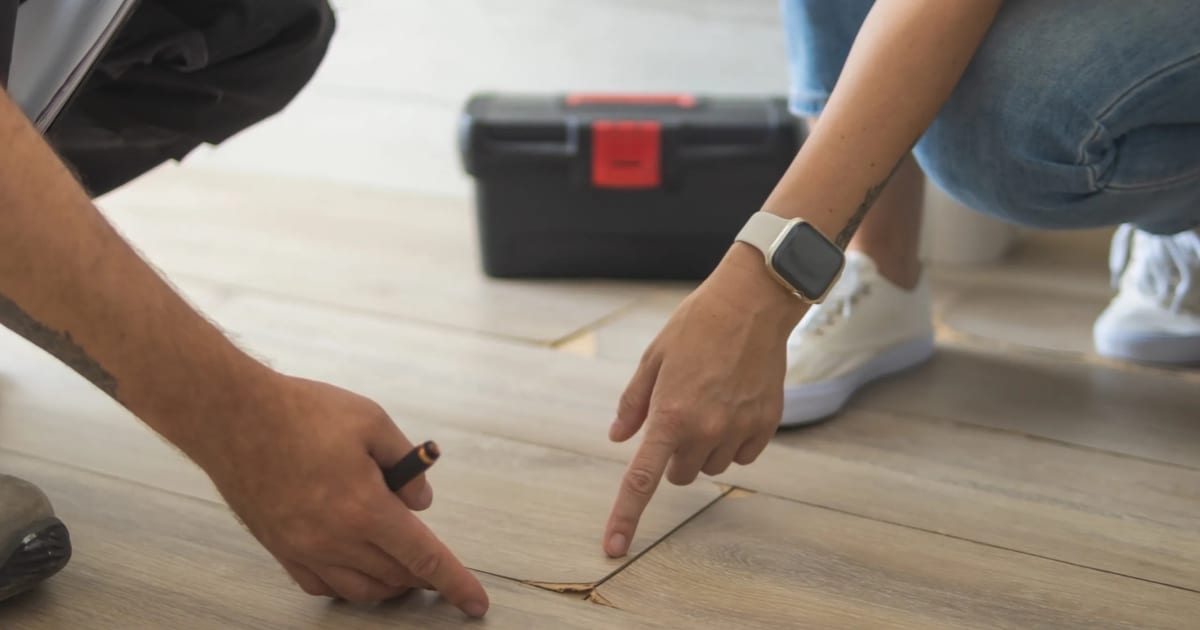
If your hardwood floors have been affected by water, the most useful next step is a professional assessment — not a quote for refinishing or replacement, but an honest look at what the floor is doing, what the moisture readings show, and what the realistic options are.
DR.FLOOR serves homeowners throughout the Dallas–Fort Worth area, including Fort Worth, Colleyville, Southlake, Keller, Grapevine, Arlington, and Dallas. We bring moisture meters and flooring expertise to the assessment, and we will tell you what we actually see — including when repair is not the right answer.
If you have recently experienced a water event or have noticed cupping, buckling, or staining in your hardwood floors, request a free estimate and we will schedule a time to come take a look.
Related reading: Should You Refinish or Replace Your Hardwood Floors? · How Long Does Hardwood Floor Refinishing Take? · Engineered vs. Solid Hardwood Flooring
Explore Topics
Written by
DR.FLOOR Team
Content creator and writer sharing insights and stories.